
In cybersecurity, one of the biggest frustrations isn’t always the attack itself, it’s the noise.
Every day, security teams are flooded with alerts. Many of these turn out to be false positives, harmless activity flagged as a threat.
On paper, that doesn’t sound too bad. After all, better safe than sorry, right?
But in reality, false positives create real problems:
- Alert Fatigue: Teams drown in meaningless notifications, making it harder to spot genuine threats.
- Wasted Resources: Time and money are spent investigating activity that poses no risk.
- Missed Attacks: When teams stop trusting alerts, real threats can slip by unnoticed.
The irony? In trying to be “overprotective,” old defence systems end up leaving organizations exposed.
Why Traditional Systems Fall Short
Most traditional defences rely on static rules and signatures. If something doesn’t fit the “known safe” profile, it gets flagged. But modern digital environments are far from static:
- Users log in from new devices.
- Businesses roll out rapid updates.
- Traffic patterns shift with promotions or seasonal demand.
All these perfectly normal changes can be mistaken for malicious behavior. The result? False alarms that compromise trust in the system.
The Autonomous Advantage with CADE
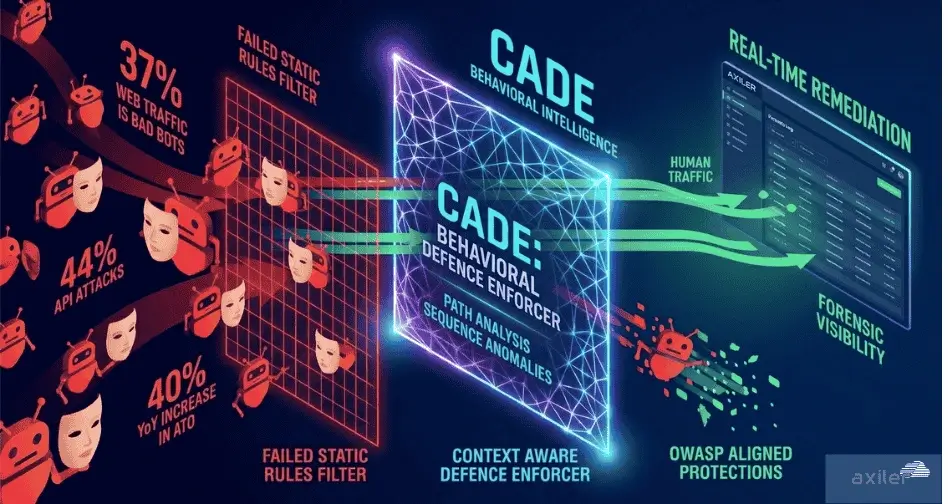
This is where Axiler CADE (Context Aware Defence Enforcer) changes the game.
Instead of relying only on rigid, rule-based defences, CADE uses AI to understand context and behavior in real time:
- Learns Behavior Patterns: CADE recognizes what “normal” looks like across your infrastructure, then automatically adjusts as that baseline evolves.
- Spots Real Anomalies: Its predictive anomaly detection and machine learning engines filter out safe but unusual activity, surfacing only genuine threats.
- Self-Healing Security: CADE doesn’t just detect threats, it auto-generates rules, patches bypasses, and reinforces defences without waiting for human intervention.
- Reduces Manual Workload: By automating rule generation and threat assessment, CADE cuts false positives and eliminates repetitive manual interventions. This directly saves SecOps time and translates into up to 40% lower labour costs for security operations.
- Responds Faster: CADE blocks a wide range of OWASP Top 10 vulnerabilities, including SQL Injection, XSS, and SSRF, along with other advanced threats like command injection and remote code execution, achieving 90.74% balanced accuracy.
Think of it as the difference between an overactive smoke alarm that screams at burnt toast, and a smart detector that only goes off when there’s real fire.
Business Impact: More Than Just Fewer Alerts
Reducing false positives isn’t only about efficiency. It’s about trust and resilience:
- Teams regain confidence in their security tools.
- Critical threats are detected faster, lowering risks of downtime or breaches.
- Operations run smoother, with less disruption caused by unnecessary investigations.
In other words, smarter filtering leads to stronger protection.
Conclusion
False positives may seem like a minor inconvenience, but in the high-stakes world of cybersecurity, they can be just as damaging as missed threats.
With CADE, Axiler brings autonomous defence that cuts through the noise, reduces alert fatigue, and sharpens focus on what truly matters: stopping real attacks.